


XENONnT: First Measurement of Low-Energy Solar Neutrinos Scattering off Electrons
2026-09-01
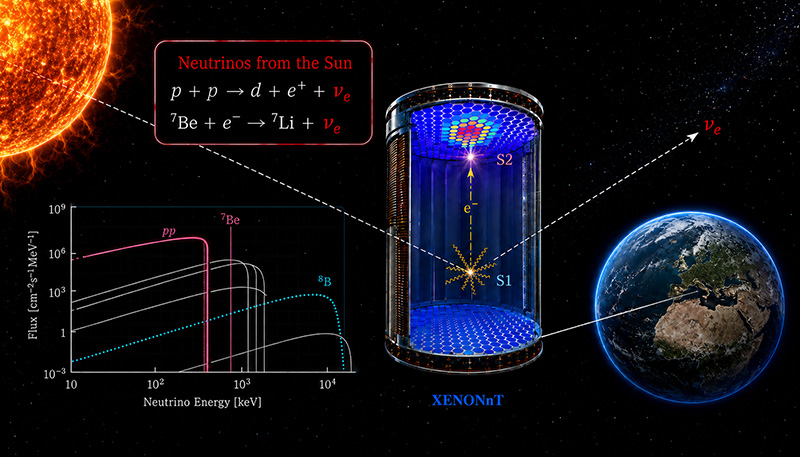
Conceptual illustration of neutrinos, produced by nuclear fusion in the Sun, scattering off electrons inside the XENONnT detector. The graph at lower left shows the energy spectrum of solar neutrinos; the most abundant at low energy are the pp neutrinos. A pp neutrino is the electron neutrino released when two protons (p) fuse inside the Sun to form deuterium and a positron. Once released, it travels from the solar core to the Earth, and a small fraction of these neutrinos are detected by the recoil they impart to electrons inside the XENONnT detector. Many different fusion reactions in the Sun produce neutrinos, but pp neutrinos are the most abundant, because they come from the reaction that generates most of the Sun’s energy. (Image credit: XENON Collaboration)
Issuing Institutions
XENON Collaboration
Institute for Space-Earth Environmental Research (ISEE), Nagoya University
Kobayashi-Maskawa Institute (KMI), Nagoya University
Graduate School of Science, Kobe University
School of Science, Institute of Science Tokyo
Kavli Institute for the Physics and Mathematics of the Universe (Kavli IPMU, WPI), The University of Tokyo
Institute for Cosmic Ray Research (ICRR), The University of Tokyo
Main Text
Every second, tens of billions of neutrinos produced by nuclear fusion in the Sun pass through every square centimetre of the Earth – and through our bodies – almost without interacting. Although they are one of the most abundant particles emitted by the Sun, their extremely weak interactions make the detection of these elusive particles one of the greatest experimental challenges in particle physics.
Today, during a seminar hosted by the INFN Laboratori Nazionali del Gran Sasso (LNGS), Italy, the XENON Collaboration announced the first observation of low-energy solar neutrinos scattering off electrons in the XENONnT detector. The measurement extends the frontier of direct neutrino observations down to neutrino energies of about 17 keV, the lowest neutrino energy threshold ever achieved. The detected signal is dominated by pp neutrinos, produced in the proton-proton fusion reactions that power the Sun and account for the vast majority of its neutrino emission.
XENONnT was originally designed for the direct search for particle dark matter in our Galaxy. At its heart is a dual-phase xenon Time Projection Chamber containing 5.9 tonnes of ultra-pure liquid xenon, installed at LNGS, 1,400 metres beneath the Gran Sasso massif. The detector is surrounded by water Cherenkov detectors that identify and reject cosmic-ray muons and neutrons, and it is capable of reconstructing the tiny flashes of light and ionization signals produced when a particle interacts with the xenon target.
Observing this feeble low-energy neutrino signal at 5σ – the statistical significance conventionally used in particle physics to claim a discovery – required not only reducing the detector backgrounds to unprecedented levels of purity but also quantifying them precisely. The dominant challenge comes from trace amounts of radioactive radon constantly released by detector materials. Over many years, the XENON Collaboration has pioneered techniques to suppress this background through extensive material screening and a dedicated online cryogenic distillation system that continuously removes radon from the xenon. The Collaboration identified and constrained every relevant background contribution at exceptionally low rates, including beta decays from lead and krypton isotopes, smaller contributions from material-induced gamma rays, as well as other subdominant components.
The result further expands the scientific reach of XENONnT. Following the recent observation of coherent elastic neutrino-nucleus scattering from higher-energy solar neutrinos, this new measurement demonstrates that the same detector can probe complementary aspects of neutrino physics, while continuing its primary search for dark matter. XENONnT is thus emerging as one of the world’s most sensitive observatories for rare low-energy particle interactions.
The measurement also builds upon a long tradition of solar-neutrino research at LNGS. GALLEX/GNO provided the first measurements of the low-energy solar neutrino flux using radiochemical techniques, while Borexino pioneered the real-time spectroscopy of individual solar neutrino interactions with a neutrino energy threshold of 335 keV. XENONnT now extends this legacy, lowering the solar-neutrino energy threshold to 17 keV.
Beyond this achievement, XENONnT offers a glimpse of the future of rare-event physics. The technologies developed to build and operate one of the cleanest particle detectors are laying the foundation for the next generation of liquid-xenon observatories. The planned XLZD experiment, with a target mass an order of magnitude larger than XENONnT, aims to extend the search for dark matter to the highest sensitivities ever achieved and to measure low-energy solar neutrinos with exceptional precision, while opening new opportunities in neutrino physics and the study of other extremely rare processes.
“This observation of low-energy solar neutrinos demonstrates how advances driven by the search for dark matter are opening entirely new windows on the Universe,” said Elena Aprile, Professor at Columbia University and spokesperson of the XENON Collaboration. “It shows that technologies originally developed to observe some of the rarest interactions in nature are now enabling us to explore fundamental questions well beyond their original scientific goals.”
Nagoya University’s Contribution
The group at the Institute for Space-Earth Environmental Research (ISEE) and the Kobayashi-Maskawa Institute (KMI), Nagoya University, has worked on XENONnT as a core group for many years. The observation was also one of the science goals long pursued by the XMASS experiment at the Kamioka underground laboratory, and many of the researchers participating from Japan inherit the scientific vision and techniques of XMASS.
Because the signal left by solar neutrinos is so faint, every other source of look-alike events — the background — has to be tracked down one by one and its contribution estimated precisely. Masatoshi Kobayashi, Designated Assistant Professor at ISEE, played a central role in that analysis. Serving as the analysis lead for this result, he directed the painstaking analysis work that established the first observation, across the international collaboration.
Researchers’ Comments
For more than 20 years, going back to my student days, I have worked on rare-event searches with liquid xenon. It is deeply rewarding to see the ultra-low-background techniques we honed for dark matter searches lead to a new physics result — the observation of solar neutrinos. Going forward, I want to carry this technology into the next-generation XLZD experiment and draw on that experience to push further toward the discovery of dark matter and new developments in neutrino physics.
Masaki Yamashita, Professor and Principal Investigator, Institute for Space-Earth Environmental Research (ISEE), and Kobayashi-Maskawa Institute (KMI) , Nagoya University; Chair of the XENON Collaboration Board
We can finally report on the observation of low-energy solar neutrinos, one of the key goals of the XENONnT experiment. This result is the fruit of the ultra-low-background techniques the collaboration has developed over the years, including the reduction of radon, and I am delighted to have contributed to it as the analysis lead. The XENONnT experiment is currently upgrading the detector and running tests toward data taking, and with the improved detector we will continue to pursue the physics of dark matter and the nature of neutrinos.
Masatoshi Kobayashi, Designated Assistant Professor, Institute for Space-Earth Environmental Research (ISEE), Nagoya University; analysis lead of the XENONnT experiment
Publication
Title: First Measurement of Solar Neutrinos through Elastic Neutrino-Electron Scattering at the keV Scale
Authors: XENON Collaboration (E. Aprile et al.)
Preprint: arXiv:2608.29450 [hep-ex] (submitted 29 August 2026)
DOI: 10.48550/arXiv.2608.29450
Related Releases
2026-09-01 – XENONnT: First Measurement of Low-Energy Solar Neutrinos Scattering off Electrons | XENON Collaboration
2026-09-01 – XENONnT: First Measurement of Low-Energy Solar Neutrinos Scattering off Electrons | Kobayashi-Maskawa Institute (KMI), Nagoya University
Related Links
XENON Collaboration
INFN Laboratori Nazionali del Gran Sasso (LNGS)