Ionospheric response to solar radiation spectrum
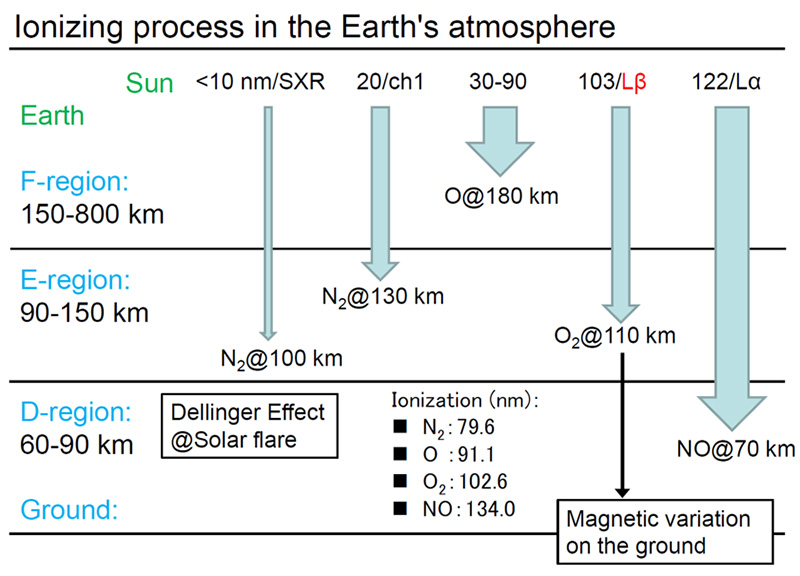
Solar radiation ionizes the Earth’s neutral atmosphere to generate the ionosphere. In this research project, we aim to quantitatively clarify the response of the electron density and electric conductivity of the Earth’s ionosphere to variations in solar radiation. At present, the relationship between solar radiation intensity, represented by daily indices such as the solar radio flux F10.7 index, and ionospheric physical quantities has been studied. However, the relationship between the solar radiation spectrum and the ionospheric response is not well understood even qualitatively, particularly during solar flares.
In this study, we will use numerical calculations to predict the relationship between the wavelength-dependent solar radiation spectrum, rather than solar radiation indices, and the electron density and electric conductivity of the ionosphere. A solar radiation spectrum model will be used as input, and the results will be validated by comparison with altitude-resolved ionospheric electron density data obtained from existing EISCAT radar observations and data on the altitude of the E-layer electron-density peak obtained from ionosonde observations. In the future, solar radiation spectrum data (17–122 nm) obtained by the SOLAR-C satellite, scheduled for launch in 2028, will be used as input, and the results will be validated by comparison with observations by EISCAT-3D radar, which began in 2026.
In studies of the Earth’s ionosphere, solar radiation has traditionally been represented by indices such as the solar radio flux index. Future observations of the solar radiation spectrum by the SOLAR-C satellite are expected to reveal that temporal variations in solar radiation differ with wavelength. Prior to the launch of the SOLAR-C satellite, this project will predict the ionospheric response to the solar radiation spectrum.